Immediate Crisis & Panic Reset
Visual Orienting When experiencing acute panic, your brain can get trapped in an internal loop of fear. Looking around the room takes very little physical effort and immediately forces your brain to recognize that you are safe in your present environment. Slowly look around the space you are in and silently name three objects and their colors (e.g., “blue chair, white clock, green plant”) to actively break the panic loop.
The 5-4-3-2-1 Senses Technique This grounding technique pulls your awareness through all five of your physical senses to anchor you in the present moment. Look around and name 5 things you can see, 4 things you can physically feel/touch, 3 things you can hear, 2 things you can smell, and 1 thing you can taste.
Cold Water Reset Rapid cooling is one of the fastest ways to interrupt a severe panic attack. It activates the “mammalian dive reflex,” a biological response that instantly forces your heart rate to slow down. Splash freezing cold water on your face, hold an ice cube in your hand, or place a cold wet washcloth over your eyes and cheeks for 15 to 30 seconds.
Deep Pressure & Heavy Work When you feel detached, floaty, or disconnected from your body, giving your muscles deep resistance helps your brain “find” your limbs again. Try standing up and pushing your hands firmly against a solid wall, carrying a heavy stack of books, or wrapping yourself tightly in a heavy blanket.
Calming Breathwork
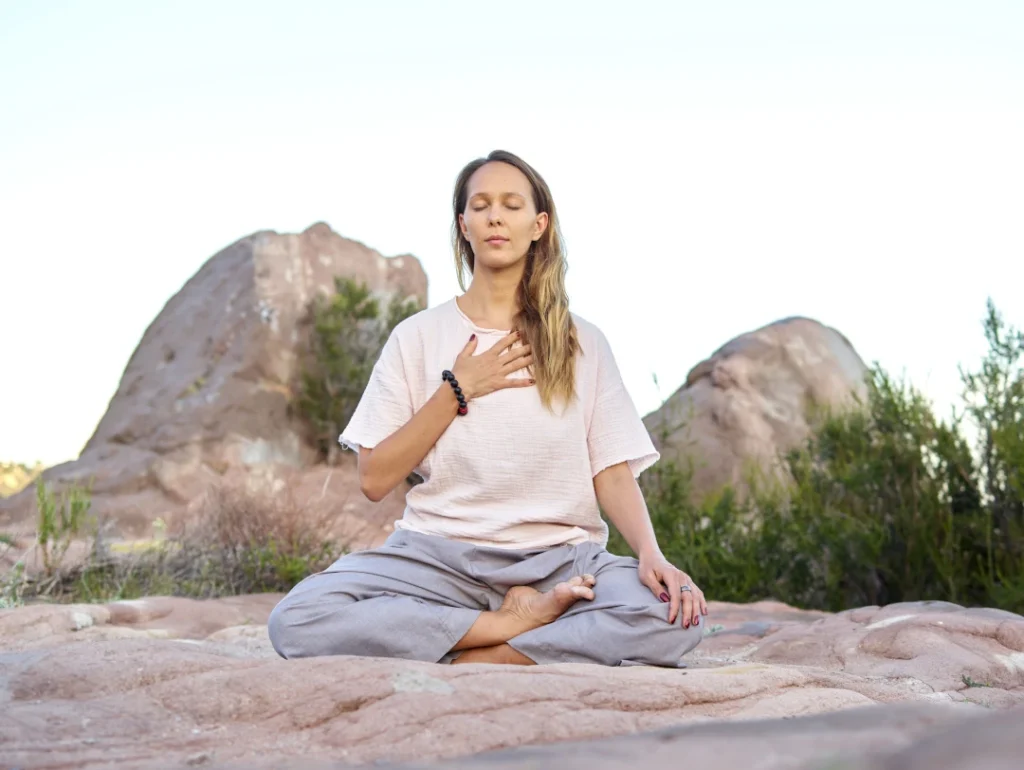
Belly Breathing Breathing deeply into your belly stimulates the vagus nerve, signaling your brain to lower your heart rate and shift out of fight-or-flight. Place a hand on your stomach and breathe in slowly, allowing your stomach to expand outward like a balloon, rather than letting your chest and shoulders rise.
Long Exhale Breathing Biologically, inhaling speeds up your heart rate slightly, while exhaling slows it down. By intentionally making your exhale longer than your inhale (for example, inhaling for a count of 4 and exhaling for a count of 6 or 8), you manually pump the brakes on your nervous system.
The “Voo” Breath Pioneered by Peter Levine, this breath uses a deep vocal vibration to physically signal your nervous system to shift into a resting state. Take a deep breath into your belly, and as you exhale, make a low, rumbling “Vooooo” sound (like a foghorn). Feel the vibration in your chest and throat to naturally soothe the vagus nerve.
The Lunar Breath This breath uses subtle mouth and throat shapes to effortlessly lengthen your exhale. It acts like a slow-release valve for anxiety, melting tension without forcing you to “breathe deeply” if deep breathing feels uncomfortable.
Wave Breathing Trauma and distress often lock us into shallow, rigid chest breathing. This practice gently stretches the torso and retrains the body to breathe in a natural, fluid, wave-like motion from the belly up to the chest.
The Rounded Breath This gentle, imaginative breath eliminates the harsh “stop-and-start” edges of anxious breathing, smoothing your breath cycle into a continuous, calming loop without any pauses between the inhale and exhale.
Deflating the Tire of Anxiety When high stress builds up in the body, it can feel like a tire overinflated with air. This exercise uses counting to safely “let a little air out” of the stress, releasing pressure slowly and securely.
Sighing Exhale Breath When you notice yourself drifting into emotional overwhelm, taking a normal breath in and releasing it with a loud, vocalized sigh drops tension immediately and shifts your nervous system back to a regulated state.
Color and Body Center Breathwork This exercise guides your nervous system through the primary physical centers of the body by visualizing specific, soothing colors filling each region as you breathe.
Heart Rate Biofeedback Training Biofeedback training teaches you to control your stress levels by matching your breathing to a specific rhythm while visually watching your heart data respond on a phone app. (Recommended Apps: Elite HRV, HeartMath, HRV4Training, Welltory).
Sensory Grounding & Soothing
Finding Your Physical Balance Point Anxiety often pulls our energy up into our heads and pushes our posture forward. Locate your exact center of gravity by standing up, swaying gently back and forth, and settling into the center to literally “find your footing.”
Mindful Grounding Firmly plant your feet on the floor, noticing how gravity supports the weight of your legs. If possible, walk barefoot on grass, soil, or sand to physically release tension and reconnect with the solid earth beneath you.
Soothing Your Senses Deliberately comfort your physical senses to communicate safety to your brain. Use warm baths, weighted blankets, rocking chairs, soothing candles, soft fabrics, calming colors, or nourishing warm foods.
Humming for Nervous System Soothing Generating a low, continuous humming sound is a simple way to soothe anxiety. The gentle vibration travels directly through your chest, throat, and vocal cords, directly stimulating your calming vagus nerve.
Gentle Self-Touch When stress leaves you feeling fragmented, use gentle self-touch to harmonize your nervous system. By gently holding different parts of your body—like placing one hand on your forehead and one on your heart—you create a safe internal bridge that helps your body remember how to feel calm.
Internal Awareness & Settling
Mapping Physical Sensations Use the Body Map & Sensations Inventory as a vocabulary guide to help you identify and map exactly where physical sensations live in your body, turning overwhelming anxiety into measurable physical data.
Dual Awareness (Inside and Outside Focus) When internal trauma triggers feel overwhelming, focusing only on your body can be too intense. Dual Awareness is the practice of paying attention to your internal feelings and the safe, external environment at the exact same time, acting as an anchor.
Mindful Body Scan This exercise checks in with your physical baseline and builds awareness of where your body holds tension without trying to force it to relax. (Guided Practice: 10-Minute Body Scan video by Dr. Elisha Goldstein.
Gentle Movement Body Scan While traditional body scans require absolute stillness, complete immobility can cause anxiety for some survivors. This scan invites gentle, barely visible physical motion as you check in with different muscle groups.
Autogenic Training (Warmth and Heaviness) Autogenics uses repeating internal suggestions (e.g., silently repeating, “My right arm is heavy and warm”) to cue deep muscular relaxation and body settling.
Movement & Physical Release
Deep Hip Muscle Release The psoas is a deep muscle connecting your spine to your pelvis. It contracts instantly to pull your body into a protective curl during danger, often trapping survival energy. Passive stretches help discharge this tension gently.
Tension Release Tremoring After a stressful event, mammals naturally shake or tremble to release excess adrenaline. Humans often suppress this urge, trapping tension in the muscles. Allowing your body to naturally shake safely releases this survival charge. Start with short sessions of 10–15 minutes and stop anytime (Guided Practice). For a more structured program, the Online TRE Course offers its first guided session free. Safety first: If you have significant trauma, injuries, back or hip problems, or other medical conditions, check with your therapist, doctor, or a certified TRE provider before starting. You can stop the tremoring anytime by lying flat with your legs straight.
Progressive Muscle Relaxation (PMR) Chronic anxiety trains your muscles to stay tight. PMR involves intentionally tensing a specific muscle group for 5 seconds, and then fully releasing it, to teach your body the physical difference between tension and relaxation. (Guided Practice).
Mindful Walking Mindful walking channels nervous energy into a deliberate rhythm, paying close attention to the feeling of your feet hitting the pavement, making it a great alternative to sitting still.
Wall-Sit Grounding Emotional overwhelm can leave the body feeling physically weak or collapsed. This standing strength exercise (leaning in a squat against a wall) activates your large leg muscles, providing an immediate sense of bodily strength and boundaries.
Yoga & Mindful Movement Engage in gentle yoga, tai chi, or movement practices that intentionally connect your breath with physical motion to build somatic awareness.
General Movement & Exercise Engage your body in movement that feels good just for the sake of moving. Moderate movement provides vital benefits for your brain: it supports brain cell health, reduces “brain fog,” and naturally regulates your mood and attention by completing the stress cycle.
Daily Foundation & Body Care
At-Home Recovery Tools Use physical aids like massage guns, foam rollers, acupressure mats, or heating pads to relieve tight muscles and physical holding patterns built up from hypervigilance.
Body Care & Physical Therapies Work alongside trusted professionals—such as massage therapists or physical therapists—or exchange gentle, supportive touch with safe friends and partners to help release chronic tension stored deep in the fascia and muscles.
Consistent Nourishment Support your baseline mood through regular, balanced meals and hydration. When meals are skipped or blood sugar drops, the body naturally releases stress hormones (like cortisol and adrenaline) that the brain can easily misinterpret as anxiety or a panic attack.
Educational & Support Footers
Educational Videos & Visual Guides
- TRE Videos & Providers: Explore more Tension & Trauma Releasing Exercises videos on the TRE FOR ALL YouTube Channel, or find a certified provider or low-cost online group at treglobal.org.
Support Handouts & Worksheets
- Body Map & Sensations Inventory
A vocabulary guide to help you identify and map where physical sensations live in your body.
Guided Audio & Practice Recordings
- 10-Minute Mindful Body Scan: An accessible scan by Dr. Elisha Goldstein.
- Trauma-Informed Yoga Channels: Recommended home movement practices by Kathie Overeem, PhD; Yoga With Adriene; Caitlin K’eli Yoga; and Hannah Uiri.
Support Apps & Digital Tools
- UCSD Center for Mindfulness Audio Library: Free library of guided movement recordings.
- Breathe2Relax: A visual breath pacer.
- iBreathe: A clean guided breathing timer (iOS App Store).
- Elite HRV: A highly accurate, free biofeedback app. (Requires compatible Bluetooth chest strap).
- HeartMath (Inner Balance): The clinical gold standard for coherence training. (Requires purchased ear-clip).
- HRV4Training: Uses your phone’s camera to measure your morning stress baseline.
- Welltory: Uses your smartphone camera or Apple Watch to measure stress and energy levels.